Attorney Spotlight: Luke Abel, Oklahoma City Trial Lawyer
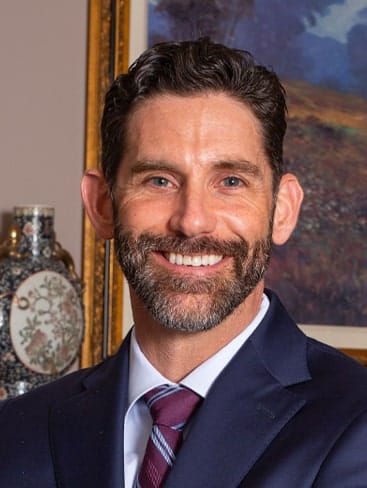 Luke Abel had been practicing law for not quite nine years the summer The Oklahoman‘s editorial board took one of his cases and offered it to readers as proof that lawsuit reform was working. An Oklahoma County jury had awarded $15 million to Todd Beason, a Yukon rig hand whose left arm was crushed under a falling crane boom and amputated twice, and a judge had cut the award by more than a third under a state cap on damages for pain and suffering. The paper published its editorial on July 9, 2015. Two days later Abel answered it in the same section under his own byline, setting out what the two categories of damages actually cover and what the cap had taken from his client.
Four years after that exchange the Oklahoma Supreme Court struck the cap down, in Beason’s own case, and Abel was one of the lawyers who put it there. He owns Abel Law Firm, the Oklahoma City practice his father Ed founded in 1976 and which turned fifty this year, and he has been counsel in three cases decided by the state’s highest court since 2018. He arrived at the work by an unhurried route: a finance degree from the University of Oklahoma in 2003, a term at Brasenose College, Oxford, then law school back in Norman and a Juris Doctor in 2006.
You know, any time things don’t go their way, it is about activist judges, bad for business, doctors are going to be run out of our state. All of our insurance premiums are going to go sky high.
I don’t believe it. And I don’t believe they believe it, but that is how they sell it to the public.
— T. Luke Abel, to the Tulsa World
The everyday work is ordinary plaintiff’s practice and a great deal of it: car accidents and truck collisions, oil and gas field injuries, defective products, nursing home cases, wrongful death. On top of that sits a short run of constitutional arguments, brought for people who were hurt at work and then told by statute that the courthouse was closed to them.
Oxford, Norman, and His Father’s Firm
Abel finished a business degree in finance at Oklahoma in 2003, studied at Brasenose College in Oxford, and took his Juris Doctor from the University of Oklahoma College of Law in 2006. He had been interning at his father’s firm since 2004, so joining it as an associate meant walking back into a building he already knew. The Oklahoma bar admitted him that September. Two decades on, he owns the place.
Ed Abel was diagnosed with Type 1 diabetes at eight and began losing his sight in his thirties, and he went on trying cases for another four decades with assistants reading the files aloud to him. He founded the firm in 1976 as Abel, Musser, Sokolosky & Clark, co-authored the Oklahoma Evidence Code, was inducted into the American College of Trial Lawyers, and kept coonhounds, cattle and bees on his ranch. He died on June 18, 2024, at eighty-two, and the firm’s website now carries a page in his memory.
The Case He Argued Alone
On October 6, 2014, a trucking company employee named David Chambers was sent to an oil well outside Crescent, Oklahoma, to pick up waste water. He worked on or around a heater treater, the equipment that separates oil, gas and water coming off a well, and suffered burns severe enough to kill him. His daughter, Glory Strickland, sued the company that owned and operated the well.
The defense spent little of its energy on what had happened at the well, arguing instead that under a sentence the Legislature had added to the workers’ compensation statutes, any owner or operator of an oil or gas well counted automatically as the injured man’s employer and was therefore immune from being sued at all. A district judge refused to dismiss the case and certified the question for immediate review. When it reached the Oklahoma Supreme Court, three lawyers from a downtown defense firm appeared for the well’s owner, the Attorney General’s office sent two more to be heard on the constitutional issue, and Abel appeared for the plaintiff by himself.
In Strickland v. Stephens Production Co., 2018 OK 6, 411 P.3d 369, decided January 23, 2018, the court held the last sentence of that provision an impermissible and unconstitutional special law under Article 5, Section 59 of the Oklahoma Constitution, and severed it from the rest of the statute. Every justice who took part concurred; one recused. Cutting a single sentence left the remainder standing and put oil and gas operators back where every other Oklahoma employer already stood, obliged to prove an employment relationship before claiming immunity from suit.
The Cap That Cut His Client’s Verdict
Todd Beason was forty-one and working to move an oil rig near Wheeler, Texas, on March 16, 2012, when an eighty-foot crane boom operated by another company’s employee came down on him. He was knocked unconscious, airlifted to Amarillo, and lost his left arm across two amputations. The nerve pain that followed never left. “It is like a thunderstorm going through my body 24 hours a day,” he told the Tulsa World years afterward.
An Oklahoma County jury returned its verdict on June 8, 2015, less than three years after the suit was filed: $9 million in economic damages and $6 million for pain and suffering, $15 million in all, of which $14 million was Todd Beason’s alone and the balance his wife’s. The judge then applied a 2011 statute capping noneconomic damages at $350,000 a person. Beason’s own award fell to $9,350,000, and the couple’s combined judgment fell to $9.7 million. Jurors came out of the courthouse in tears when they learned what had happened to the number they had written down, Beason told the paper.
That reduction is what The Oklahoman held up three weeks later as an example of sound reform, and it is what Abel answered on July 11, 2015, in a guest column that spelled out the arithmetic for anyone who had not been in the room. Noneconomic damages, he wrote there, are the ones that arrive without a dollar figure attached: pain, disability, mental anguish, disfigurement such as the loss of a limb, the loss of enjoyment of life.
Four more years of appeal followed before the Oklahoma Supreme Court held, on April 23, 2019, in Beason v. I.E. Miller Services, Inc., 2019 OK 28, 441 P.3d 1107, that the cap was unconstitutional in its entirety as a special law under Article 5, Section 46, and the reduced judgment gave way to the verdict the jury had written. Five justices concurred, the chief justice concurred in part and dissented in part, and three dissented; so many members of the court had left the case along the way that two Court of Civil Appeals judges and a district judge sat in their places. None of it was Abel’s alone. Ed Abel, Lynn B. Mares and Kelly S. Bishop were on the briefs with him, along with two lawyers from the Center for Constitutional Litigation admitted for the appeal.
Reaction from the state’s political class was immediate, with the Senate president pro tempore accusing the court of hostility to lawsuit reform and the State Chamber warning that employers would now stay away from Oklahoma. Abel told the Tulsa World that caps fall hardest on the people with no economic claim to bring in the first place: retirees, stay-at-home parents, children.
Thank goodness we have the Supreme Court to save us from what the Legislature did.
— T. Luke Abel, to the Tulsa World
The court has not sided with him every time it has heard from him. In Brown v. Dempster, 2024 OK 17, 546 P.3d 244, decided in March 2024, it held that an unfenced residential swimming pool on three acres of Osage County land was not an attractive nuisance as a matter of law, and sent the case back to the district court on the narrower question of whether his client could recover on ordinary premises liability grounds.
Tracking Bills for the Bar
Long before either constitutional case, Abel spent five years as vice chairman of the Oklahoma Bar Association’s Legislative Monitoring Committee, and the writing duty that came with the job put him in the Oklahoma Bar Journal several times a session. The columns are exactly what they sound like: which bills are still alive with a week to go before sine die, which ones died in conference, what a measure exempting veterans’ disability payments from a homestead exemption calculation would actually do. He wrote them from 2011 through 2016, the years in which the damages cap was law and being defended at the Capitol.
He turns up on continuing legal education programs from time to time as well. At a 2009 seminar on personal injury practice he took the session on pre-litigation and pre-trial preparation, on a program where his father handled medical testimony in auto cases. He sits on the board of the Oklahoma Association for Justice, the state’s plaintiffs’ bar, and the firm says he served as its president in 2021. He volunteers with Oklahoma Lawyers for Children and works the Oklahoma City fundraising team for Legal Aid Services of Oklahoma, which provides free civil representation to low-income and elderly Oklahomans.
Peer recognition has followed roughly the same curve as the practice. Super Lawyers named him a Rising Star in 2010 and in every year from 2013 through 2019, then moved him to the main list, where he has appeared every year from 2020 through 2026. Best Lawyers has recognized him since 2020 in two Oklahoma City categories, plaintiffs’ personal injury litigation and plaintiffs’ product liability litigation, and Martindale-Hubbell’s peer review process rates him AV Preeminent, its highest mark.
Fifty Years In
The fiftieth anniversary turned into a television commercial, and Abel does the talking in it himself, in a spot the firm ran during March Madness. “Hi, I’m Luke Abel,” it opens. “Abel Law Firm is now 50 years old. That’s five decades of proudly serving Oklahomans.”
Most of a plaintiff’s practice resolves without ever producing a published opinion, so the two constitutional cases sit on the firm’s list of victories beside only one other result, a $5.2 million jury verdict out of McCurtain County. The firm puts its lifetime recoveries above $550 million.
When Ed Abel died two years ago, the family asked in place of flowers that donations go to Camp Sweeney, a summer camp in Texas for children with Type 1 diabetes, the disease he had lived with since he was eight years old. He left a wife, four children and six grandchildren. Luke Abel and his wife Laura live in Oklahoma City, and the office on Northeast 63rd Street still carries his father’s name.